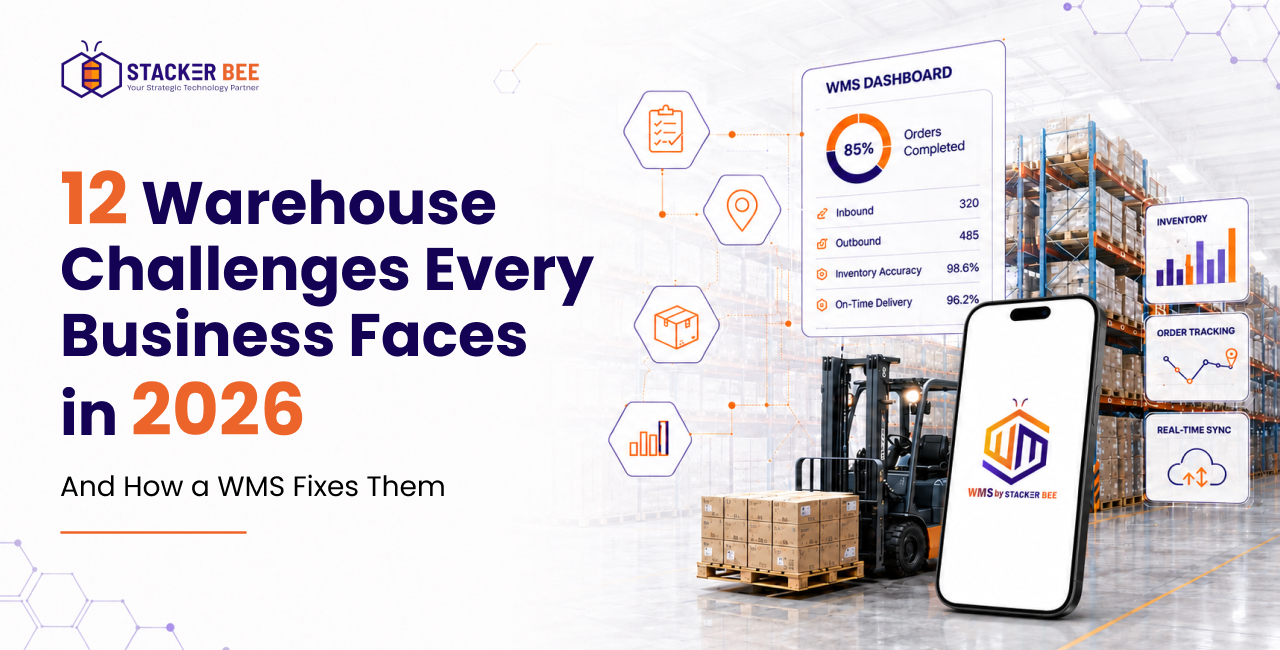
12 Warehouse Challenges Every Business Faces in 2026 - And How a WMS Fixes Them
 Sep 05, 2026
If you run a warehouse in 2026, you already know the feeling: orders keep climbing, customers expect next-day delivery and your team is still hunting for a pallet that "should be" in aisle 4 but isn't. You're not alone. Across e-commerce, retail and manufacturing, warehouse operations are under more pressure than ever - and the businesses pulling ahead aren't necessarily the ones with the biggest facilities. They're the ones with the smartest systems.
Industry data shows the global warehouse management system market was valued at over $4.7 billion, with steady growth projected through 2026 and more than 90 percent of warehouses now use some form of warehouse management software (WMS). That's not a trend driven by hype - it's driven by necessity. Manual processes and disconnected spreadsheets simply can't keep up with today's order volumes, SKU complexity and customer expectations.
In this guide, we'll walk through the 12 biggest warehouse challenges businesses are facing in 2026 and show exactly how a modern warehouse management system - like StackerBee - solves each one. Whether you're running a single facility or managing multi-warehouse operations, you'll walk away with a clear picture of where your operations might be leaking time, money and accuracy.
Why Warehouse Operations Are Under More Pressure Than Ever
Before we dive into the challenges, it's worth understanding why 2026 feels different.
Customers now expect real-time visibility, same-day or next-day fulfillment and accurate order tracking from the moment they check out - expectations that paper-based and manual systems simply cannot support. At the same time, supply chains are more global (and more fragile), labor is harder to find and retain and the sheer number of sales channels businesses sell through has multiplied. A warehouse that ran fine on spreadsheets in 2019 is often stretched to its breaking point today.
This is exactly the gap that warehouse management software is built to close. Let's break down where that pressure shows up most.
1. AI Adoption and Data Utilization Challenges
Artificial intelligence is reshaping warehousing - from demand forecasting to predictive maintenance - but most businesses still struggle to use it effectively because their warehouse data is fragmented, inaccurate or scattered across multiple disconnected tools.
How a WMS fixes it: A modern warehouse management system centralizes warehouse data in one place, giving AI and analytics tools clean, real-time information to work with. Instead of guessing at demand or safety stock levels, businesses can rely on system-generated insights that actually reflect what's happening on the floor.
2. Global Supply Chain Disruptions and Volatile Costs
Trade restrictions, shipping delays and fluctuating fuel and material costs continue to disrupt global supply chains in 2026. Businesses that lack visibility into inventory and demand often overreact - over-ordering out of fear or under-ordering and running out of stock at the worst possible time.
How a WMS fixes it: With better inventory visibility, demand planning and multi-warehouse coordination, a WMS helps businesses absorb disruptions instead of being blindsided by them. Reordering triggers and safety-stock alerts mean fewer emergency decisions made in a panic.
3. Inventory Inaccuracy
Inventory inaccuracy remains one of the most persistent - and most expensive - problems in warehousing. Manual entry and outdated spreadsheets lead to overstocking, stockouts and fulfillment errors that frustrate customers and tie up cash in the wrong products.
How a WMS fixes it: Real-time inventory tracking through barcode scanning and RFID keeps stock counts accurate down to the unit. A warehouse management system provides real-time stock visibility, which can reduce inventory discrepancies dramatically compared to manual tracking.
4. Labor Shortages and Workforce Productivity
Finding and keeping skilled warehouse staff has become one of the toughest operational challenges of the decade. As demand rises, businesses are being asked to fulfill more orders with smaller, less experienced teams.
How a WMS fixes it: Guided picking, optimized task assignment and intelligent labor management help even a lean team operate at a higher level. AI-driven features like pick-path optimization and labor forecasting reduce wasted motion and help managers spot bottlenecks before they slow down the whole operation.
5. Delayed Order Fulfillment
Same-day and next-day delivery are no longer premium features - they're baseline expectations. Even small delays in picking, packing or shipping can trigger a wave of customer complaints and returns.
How a WMS fixes it: By streamlining and automating the pick, pack and ship workflow, a WMS shortens the time between "order placed" and "order shipped." Wave picking and batch picking, in particular, let warehouses fulfill more orders in less time without adding headcount.
6. Poor Warehouse Space Utilization
Many warehouses lose usable space to overcrowded storage, poor layout planning or inefficient product placement. This drives up storage costs and slows down every worker who has to navigate a cluttered floor.
How a WMS fixes it: Smart slotting assigns storage locations based on product demand, movement frequency and available space - meaning fast-moving items sit closer to packing stations while slow movers are stored efficiently elsewhere. This alone can free up significant warehouse capacity without expanding square footage.
7. Lack of Real-Time Visibility
Without real-time data, warehouse managers are essentially making decisions based on yesterday's information. That delay compounds every other problem on this list - from stockouts to missed shipments.
How a WMS fixes it: Live dashboards give managers a real-time view of inventory levels order status and warehouse performance, so decisions are based on what's actually happening right now - not what happened hours ago.
8. Managing Multi-Warehouse Operations
As businesses expand into new regions or add fulfillment centers, keeping inventory and workflows synchronized across multiple sites becomes exponentially harder. Disconnected systems lead to mismatched stock counts and confused order routing.
How a WMS fixes it: A cloud based WMS connects every warehouse location on a single platform, giving businesses centralized control and consistent processes across sites - without needing separate systems for each location.
9. Returns and Reverse Logistics Complexity
Returns are a growing headache, especially for e-commerce businesses. Manual returns processing is slow, error-prone and often leaves returned inventory sitting unaccounted for.
How a WMS fixes it: Automated returns workflows - including inspection, restocking and inventory updates - help businesses recover value from returned goods faster and keep inventory records accurate.
10. Demand Fluctuations and Seasonal Peaks
Promotional spikes, holiday seasons and sudden viral demand can overwhelm warehouses that aren't prepared. Without planning tools, businesses either overstaff and overstock or scramble to keep up when demand surges.
How a WMS fixes it: Demand forecasting and real-time data help businesses plan staffing and inventory ahead of seasonal peaks, so they can scale up (or down) with confidence instead of guesswork.
11. Compliance and Traceability Requirements
Industries like pharmaceuticals, food and beverage and electronics face increasingly strict traceability and compliance requirements. Manual record-keeping makes audits stressful and recalls slow.
How a WMS fixes it: Batch tracking, expiry-date management and detailed audit trails make compliance a built-in part of daily operations rather than a scramble during audit season.
12. Integration Challenges with Other Systems
Many warehouses still rely on disconnected systems for ERP, transportation and inventory management - leading to data silos, duplicate entries and costly errors between departments.
How a WMS fixes it: A modern warehouse management system integrates directly with ERP, e-commerce platforms and transportation management systems, creating one connected supply chain where data flows automatically instead of being re-entered by hand.
Real-World Impact: What Businesses Actually Gain
It's one thing to talk about features - it's another to see the outcomes. Businesses that adopt a modern WMS software platform consistently report measurable improvements across the board:
-
● Higher inventory accuracy - often reaching 99%+ with consistent scanning and cycle counting
-
● Faster order fulfillment - automated picking workflows cut processing time significantly
-
● Lower labor costs - smarter task assignment reduces wasted movement and overtime
-
● Better space utilization - optimized slotting frees up capacity without new square footage
-
● Improved customer satisfaction - fewer errors and faster shipping mean fewer complaints and returns
For example, a growing e-commerce brand that expands from one sales channel to five will typically see order volume and SKU complexity spike well before headcount catches up. Without a centralized system, that gap shows up as missed orders, mismatched stock and frustrated customers. With a WMS in place, the same growth becomes manageable - inventory syncs automatically across channels and picking workflows adjust to handle the higher volume without chaos on the floor.
Best WMS for Small Business vs. Enterprise: What's the Difference?
Not every business needs an enterprise-grade system on day one. Here's how to think about fit:
Frequently Asked Questions
What does WMS mean in warehousing?
WMS stands for warehouse management system - software that manages inventory, storage, picking, packing and shipping within a warehouse or distribution center.
Is a cloud based WMS better than an on-premise system?
For most growing businesses, yes. A cloud based WMS requires less upfront infrastructure, updates automatically and can be accessed from anywhere - making it easier to scale across multiple warehouse locations.
How much does warehouse management software cost?
Pricing varies widely based on features, warehouse size and number of users. Many providers, including StackerBee, offer tiered pricing so small businesses aren't paying for enterprise-level features they don't need yet.
Can a WMS integrate with my existing ERP or e-commerce platform?
Yes - most modern WMS platforms are built to integrate with popular ERP systems and e-commerce platforms, syncing inventory and order data automatically.
How long does it take to implement a WMS?
This depends on warehouse complexity, but cloud based systems like StackerBee are typically faster to deploy than legacy, on-premise solutions since there's minimal hardware setup involved.
Final Thoughts: Turning 2026's Challenges Into an Advantage
Warehouse operations in 2026 aren't getting simpler - but that doesn't mean they have to be chaotic. The 12 challenges above are the same ones tripping up businesses across every industry, from e-commerce to manufacturing to 3PL. The difference between businesses that struggle and businesses that thrive usually comes down to one thing: whether they're still relying on spreadsheets and guesswork or running on a system built for how warehouses actually operate today.
A modern warehouse management system doesn't just fix individual problems - it changes how your entire operation runs, replacing reactive firefighting with proactive, data-driven control.
Ready to see what a future-ready WMS looks like for your business?
Schedule a free demo with StackerBee Technologies and see how much time, money and stress a smarter warehouse management software platform can save your team.
Have questions or want to share your own warehouse challenges? Drop a comment below or share this article with a colleague who's still wrestling with spreadsheets - they'll thank you later.